ERP Development

In today’s competitive landscape, ERP is more than just software; it’s a strategic necessity. It streamlines operations, enhances efficiency, fosters collaboration, trims costs, and scales with your growth. With real-time insights at your fingertips, you can make informed decisions, driving your business to new heights. Ready to transform your operations?

What is ERP?

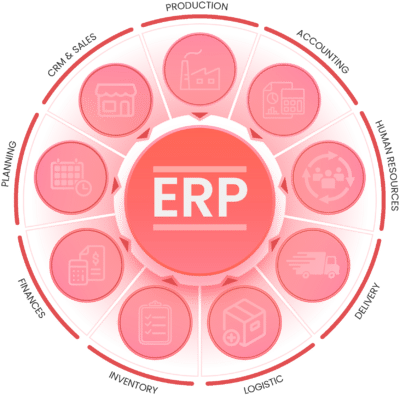
ERP, which stands for Enterprise Resource Planning, is a powerful software solution that integrates and manages various aspects of a business, from finance and HR to production and inventory. It acts as a central hub for data, streamlining processes, enhancing collaboration, and providing real-time insights.

ERP Modules We Offer

01

We design and develop mobile APIs that enable your applications to exchange data effortlessly, ensuring real-time synchronization, smooth interactions, and efficient use of resources. 

02

We seamlessly connect your software with a wide range of third-party APIs, such as payment gateways, social media platforms, and cloud services.

03

Our experts design and build APIs that act as bridges, facilitating communication between your web applications and external systems.

04

Our team of skilled developers works closely with you to identify your specific integration requirements, design the API architecture, and build a solution that seamlessly integrates with your existing systems.

05

Our experts design and build APIs that act as bridges, facilitating communication between your web applications and external systems.

06

Our team of skilled developers works closely with you to identify your specific integration requirements, design the API architecture, and build a solution that seamlessly integrates with your existing systems.

07

Our experts design and build APIs that act as bridges, facilitating communication between your web applications and external systems.

08

Our team of skilled developers works closely with you to identify your specific integration requirements, design the API architecture, and build a solution that seamlessly integrates with your existing systems.

Benefits of ERP

Streamlined Operations

Streamlined Operations

ERP systems centralize data and processes, eliminate data silos and reduce manual data entry resulting in improved efficiency.

Enhanced Productivity

Enhanced Productivity

By automating routine tasks and providing real-time access to information, ERP systems enable employees to work more efficiently, allowing them to focus on more value-added activities.

Better Decision-Making

Better Decision-Making

ERP systems provide real-time insights and reporting, allowing decision-makers to access critical data quickly. This empowers informed decision-making and enhances strategic planning.

Enhanced Collaboration

Enhanced Collaboration

ERP systems facilitate communication and collaboration across departments by providing a unified platform for data sharing and workflow management.

Cost-Efficiency

Enhanced Collaboration

SaaS applications often include collaboration tools, enabling teams to work together efficiently, share documents, and communicate seamlessly.

Customer Satisfaction

Customer Satisfaction

Access to accurate and up-to-date customer information enables better customer service. ERP systems help businesses respond quickly to customer inquiries and provide personalized experiences.

Why Partner with Soft Pyramid for ERP Development?

Expertise

Our seasoned team of eCommerce web developers possesses a deep understanding of the eCommerce landscape and has successfully completed numerous projects, helping businesses thrive.

Reliable Support

Our commitment to your success doesn’t end with website development. We offer ongoing support and maintenance to keep your site running smoothly.

Custom Solutions

We don’t believe in one-size-fits-all solutions. We work closely with you to understand your business goals and deliver tailored eCommerce development services that align with your vision.

Innovation

We stay at the forefront of technology trends and continually update our skills to ensure your eCommerce website remains competitive and up-to-date.

Want to develop ERP from scratch or an ERP module?

Tech Stacks We Use

Vue JS
JavaScript
Tailwind
Liwewire
React JS
Laravel
PHP
Node JS
JavaScript
MySQL
Mongo DB
RDS
PostgreSQL
REST API
Third Party API
PHPUnit
PESTPHP
Git lab
Github
Bitbucket
CI/CD
WordPress

FAQs About ERP Development

API Development is essential because it enables different software systems, services, or platforms to work together. It allows businesses to expand their digital ecosystems, improve data sharing, and streamline processes. APIs are the building blocks of modern software development, fostering innovation and efficiency.

The key components of API Development include designing the API structure, defining endpoints, specifying data formats (often in JSON or XML), implementing authentication methods, ensuring security, and providing comprehensive documentation for developers.

RESTful APIs (Representational State Transfer) are a type of web API that follows a set of architectural principles. They use HTTP methods (GET, POST, PUT, DELETE) and are designed to be stateless, meaning each request from a client to a server must contain all the information needed to understand and process the request. RESTful APIs are widely used for web and mobile applications.

To ensure API performance, you can optimize database queries, implement caching mechanisms, use content delivery networks (CDNs) for static assets, and design efficient API endpoints. Regular monitoring and load testing are also essential for identifying and addressing performance bottlenecks.

API versioning is the practice of specifying the version of an API in requests to ensure compatibility. It’s important because as APIs evolve, changes may break existing functionality for clients using the older version. Versioning allows clients to continue using the older version while adapting to the changes in the newer one.

Rate limiting is a technique used to control the number of API requests a client can make within a specified time period. It prevents abuse and ensures fair usage of the API by limiting the number of requests a user or application can make in a given timeframe.

Explore Other Solutions